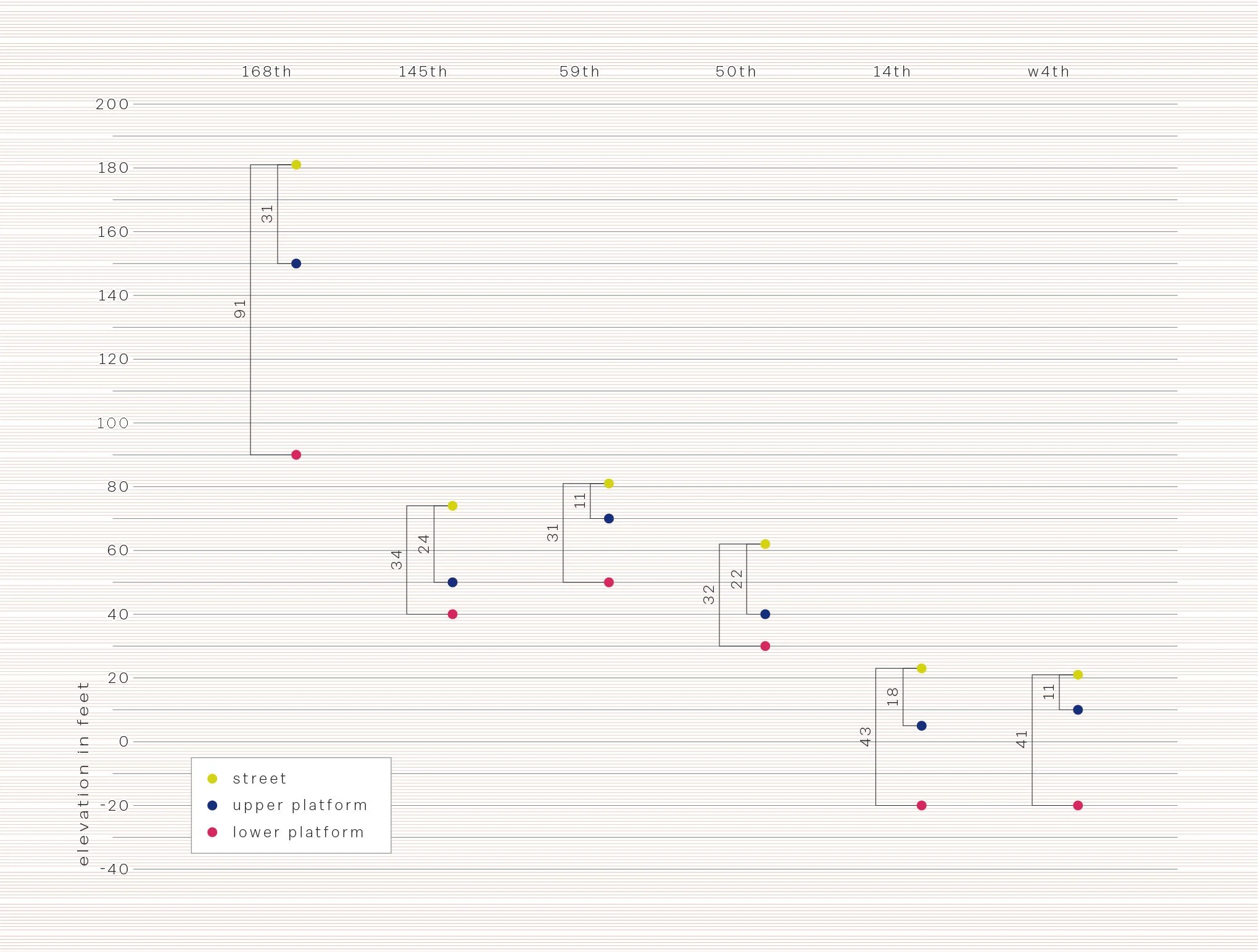
does depth matter?
the A train and PM2.5
I currently live near the deepest subway stations in NYC. When MTA expanded what were shallow subway tunnels downtown to serve the hilly heights of uptown, workers had to create extremely deep tunnels. I’ve always been curious about how this depth impacts the quality of a station: Might air quality deep down pose public health risks to those frequenting deep stations on the daily?
One way to find out might be to look at concentrations of PM2.5.
(Parenthises party (TLDR): PM2.5 = particulate matter (PM) sized around 2.5 micrometers. PM is a complex mixture of stuff (dust, smoke, soot, aerosols) that suspend in the air. A micrometer (aka micron) is a millionth of a meter (0.000001 m) and is symbolized by µm (greek µ (mu, for micro-) + m for meter). In general, finer PM has worse health effects, as the smaller the PM, the deeper it can get into our respiratory systems (LUNGS!), causing cardiovascular disease (CVD) and other respiratory diseases.)
Long story short, PM2.5 (as opposed, for example, to PM10) is dangerous and measuring it might be able to answer my question!
(By the way: this is why smoking is bad for health! When we smoke, we provide the finest PM with a shortcut that bypasses the body’s upper respiratory defenses (nose hairs, mucus-lined throat passages) and leverage the power of the inhalation to shoot them deep into our lungs, exponentially speeding up the destructive work of PM on the body.)
Because I’m interested in outdoor +/ public spaces (as opposed to indoor, usually private spaces like homes and offices), I have been equipped with a TM SidePak AM250, a relatively little guy that can be packed up and tucked away in a backpack or another unassuming hiding spot. A long intake hose sucks air from a place of interest (ideally “the breathing zone” — aka near a human’s mouth) and sends it through a PM2.5 impactor to be measured by a lazer photometer! In other words, this thing does a lot, and discretely, for such a small machine. (Never mind that it hums rather loudly when in use; it’s inaudible over the noise of the city.)
But it’s not enough simply to ride the subway with this sensor and look at data after. Shallower stations downtown might differ from deeper stations uptown in ways beyond depth. For example, stations downtown may see more foot traffic than those uptown, which can influence the amount of PM suspended in the air. There may be more train lines intersecting in downtown stations, with more frequent stops, too. In order to eliminate bias from confounding due to these variables, I would have to sample the air from different depths within the samestations.
Because it’s good to take the A train (though the deepest station is on the 1 at 191st), I started by selecting all of the Manhattan A stations that have exactly two levels. If we include 50th, where the A stops when running local, there are 7: 168th, 145th, 59th, 50th, 14th, w4th, and chambers.
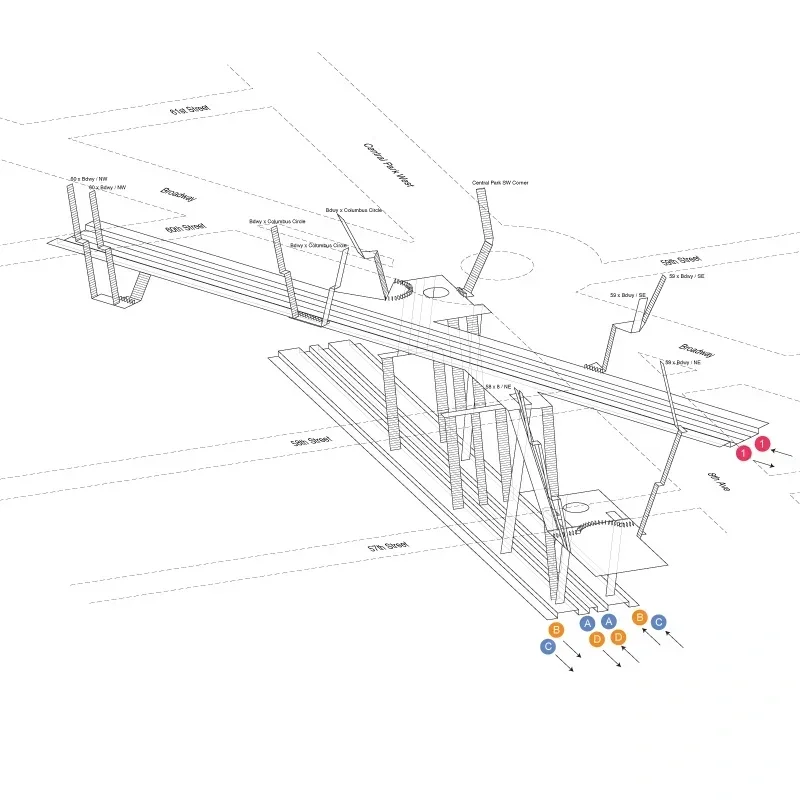
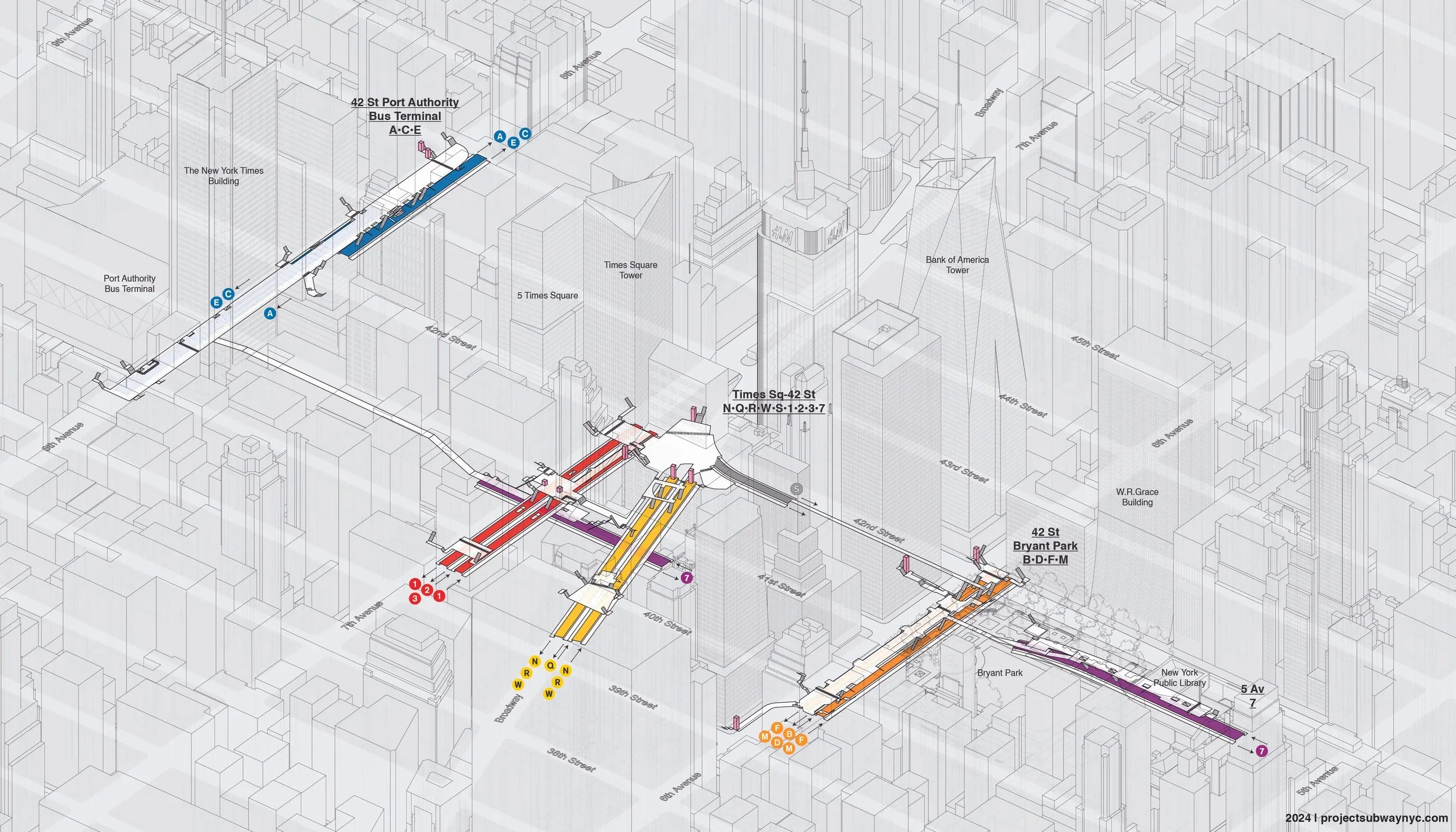
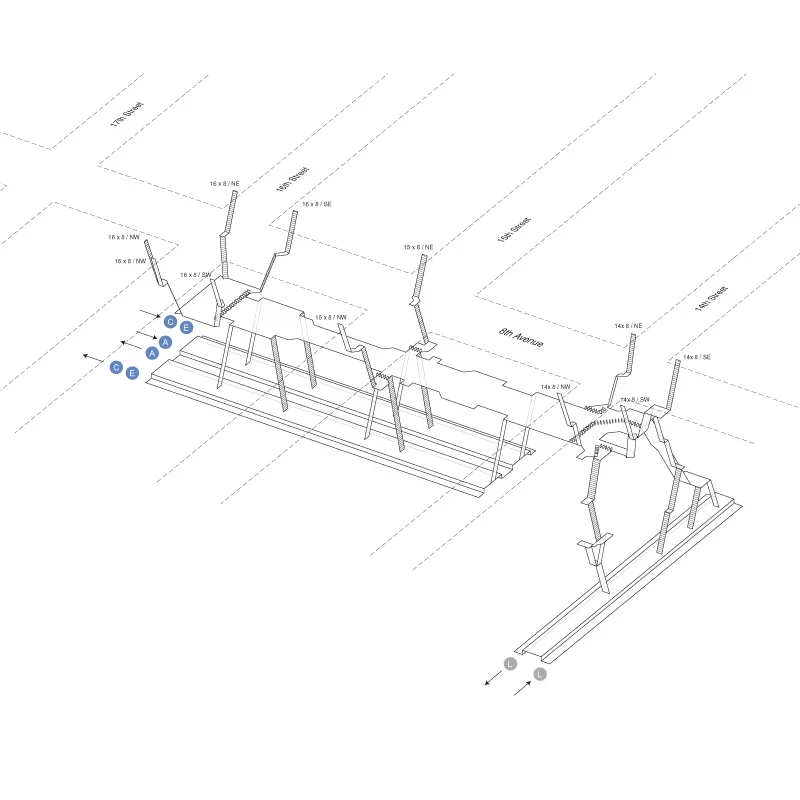
I excluded stations with more than 2 levels not out of laziness but because the levels are not even close to stacked. For example, the transfer station at 42nd street has the A train running under 8th Ave and you have to walk an entire block underground to get to the other lines; Fulton is a similar situation. The dual level stations I included aren’t perfect either, tho. 59th and 14th are definately not stacked—a classic case of limitations.
Shout out to PROJECT SUBWAY NYC, whose images I’ve shared below, for illustrating these complications so clearly. From left to right (north to south), diagrams of 59th*, 42nd, 14th*, w4th*, chambers, and fulton stations on the A line show how the so-called stacking in these multi-level stations is anything but uniform — a fun symptom of the frankenstein engineering it took to retroactively make many stations into transfers. (How boring would it be if they were all as simple as w4th?) (*included in my sample)
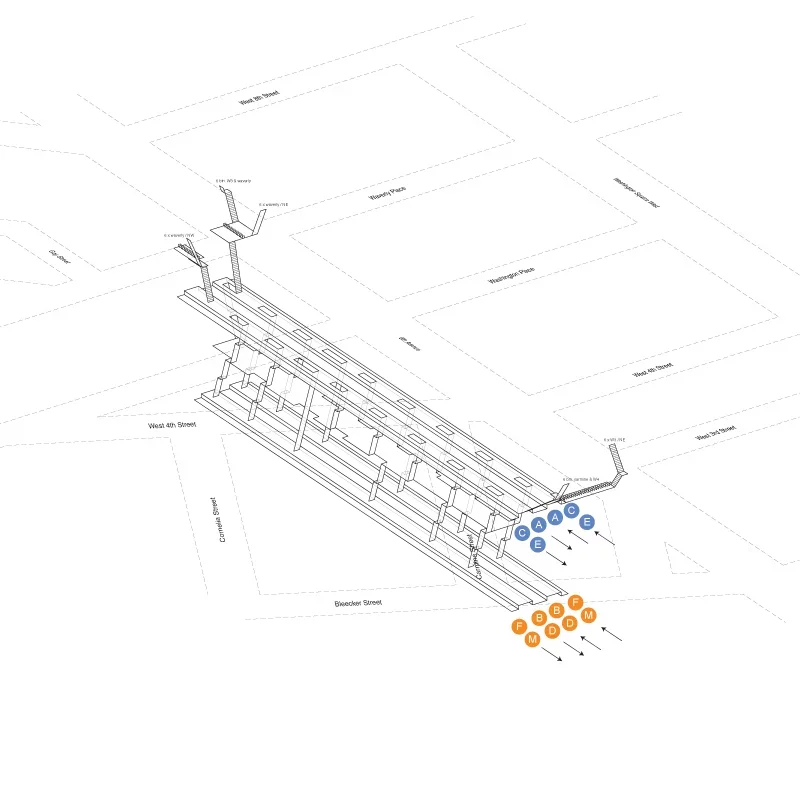
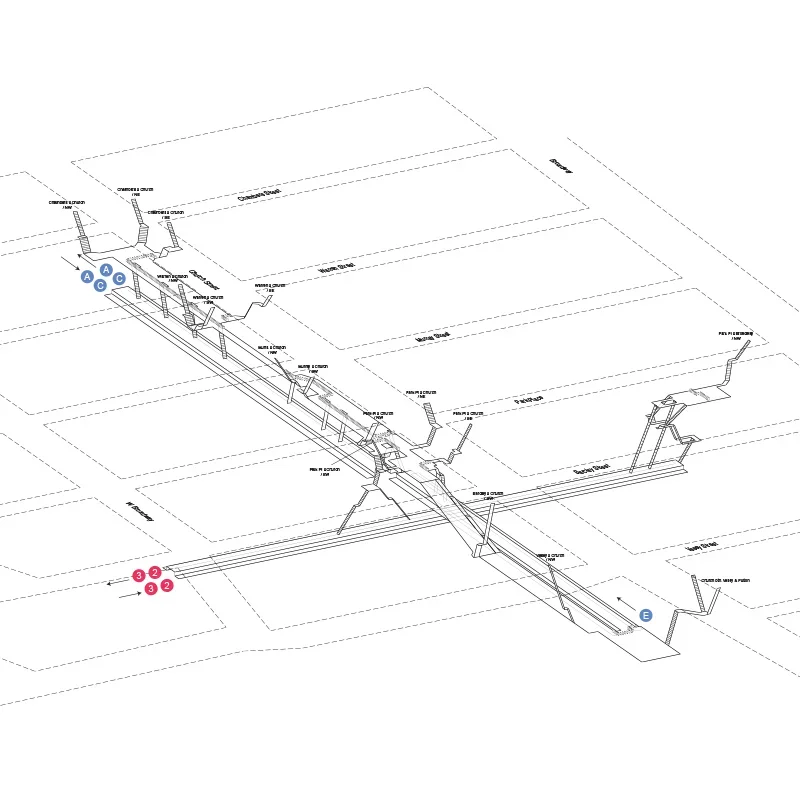
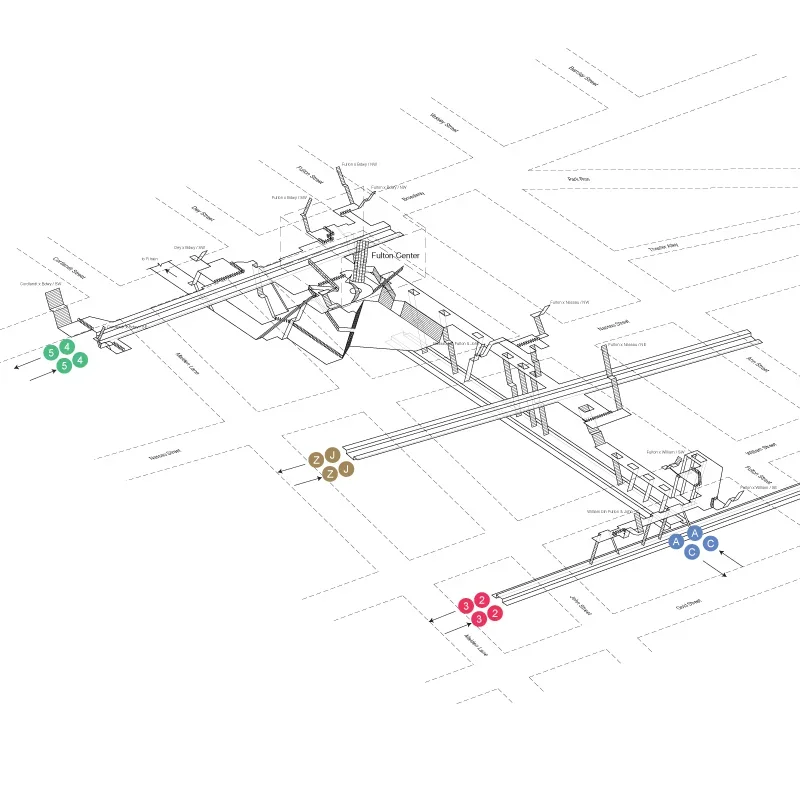
To generate excitement for data analysis, I had to explore some graphical techniques for visualizing results. I’m sharing a simple draft upon which I will build to share PM2.5 concentrations across platforms of differing depths. Oh yea, and street level is included here for good measure. Stay tuned for results!