transit (in)justice
Why the new subway faregates are racist, classist, and bad for public health
Every time I go through the pilot faregates at the 125th St ACE/BD station, my blood boils. Gone are the days when many could jump over or duck under the classic turnstiles to get a free ride. Gone are the days that a guy could linger inside the emergency door, opening it for passengers unwanting and/or unable to pay. I always supported that guy, opting for the back door in and giving him a dollar. I did this for layered reasons.
For one, the subway is expensive. It rose from $2.90 to $3 January, 2026. That price may reflect inflation, but it does not reflect inequality. That price may be affordable for a person making a living wage, but a massive proportion of New Yorkers is not. As a student with parttime work in research and teaching — both fields that are increasingly underpaid and under threat — I am not exactly high income, and saving $2 feels good. But this isn’t about me. This is about the chronic jumper-overs and ducker-unders and door-holders.
Like many neighborhoods throughout the city, Harlem has been undergoing excruciating gentrification for decades. Significant proportions of lower income residents, the vast majority people of color, have been forced to leave. Those that continue to stick it out are forced to hustle for their lives in order to stay. That means working lots of jobs, yes, and it also means saving money in any and all possible ways. These pressures subject residents to myriad public health risks. To name a few, people are incentivized to crowd into apartments, eschew preventative health practices (e.g. quality rest, diet, exercise, healthcare), and participate in informal economies (which puts people at risk of engaging with racist policing). It makes sense that economic stress is associated with chronic stress — a state of constant stress response that causes serious physical (elevated blood pressure, suppressed immune system) and mental health impacts.
People eschewing subway fairs should be taken as a sign of financial stress and understood as a sign of structural societal issues. We should be asking not “How can we force people to pay?”but rather, “How might people become able to pay?”
If paying for the subway is easy for some and not for all, how might we level the playing field? The reduced fare program is one effort toward transit equity, but it doesn’t work for everyone. In order to apply and maintain it, one must be able to apply, which requires internet and a device for connecting to it, literacy in selected languages, and proof of identity, residency, and income. Odds are, if you lack one of those, you lack others, and so the app itself puts you in a catch 22 of structural oppression. The app is disproportionately difficult for the very people who need it most.
According to the MTA’s NYC Transit Key Performance Metrics report for 2025, unpaid ridership is down from 2024 for both the subway and the bus, which sees nearly half of its riders riding unpaid. When we examine this statistic through the lens of public health, it becomes clear that this is such an important quality of the bus. We need only to decriminalize free ridership, and the bus will be the gold standard for equitable transit.
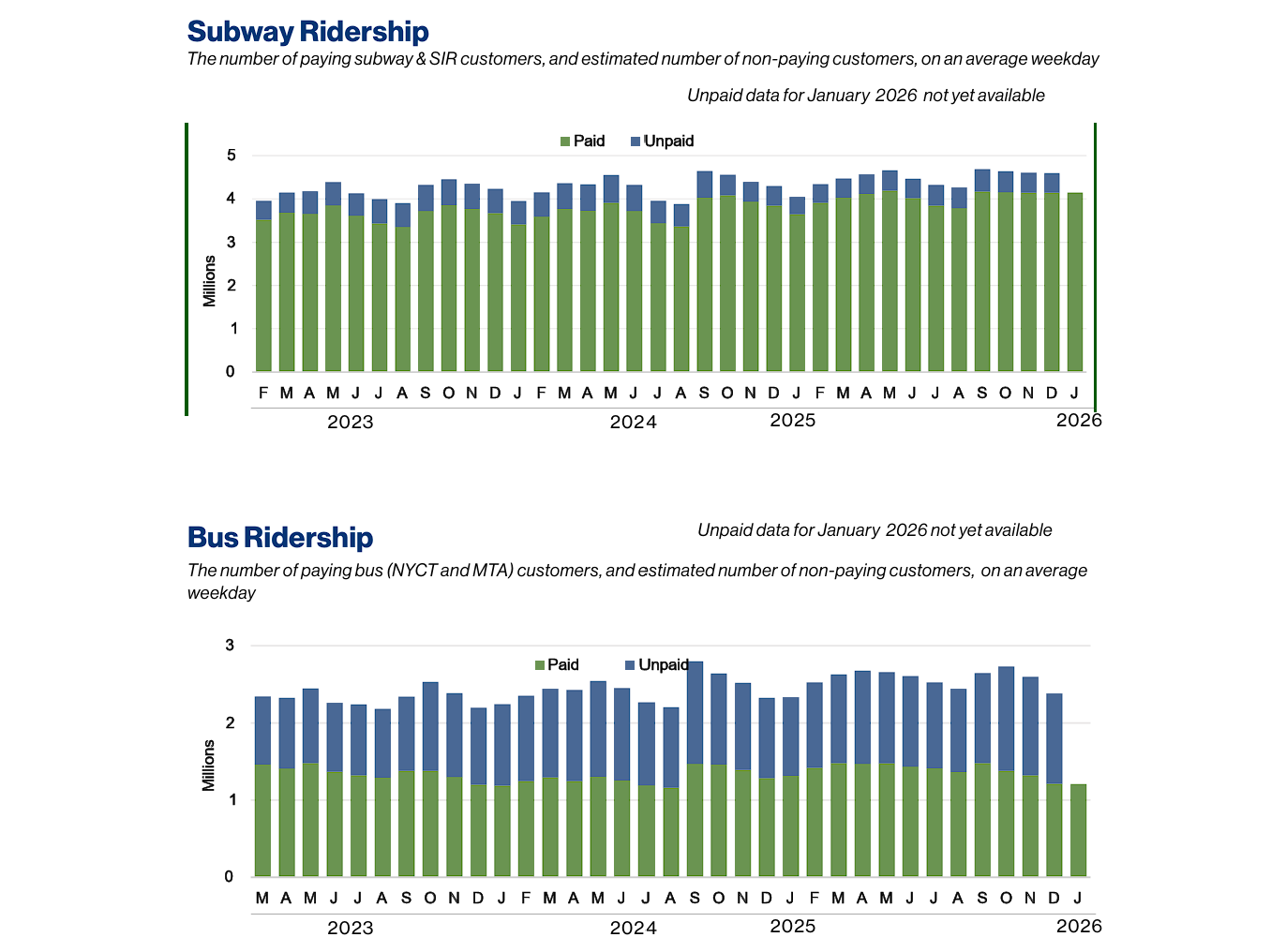
Subway and bus ridership with proportion unpaid differentiated in blue. Source: MTA
If not paired with continual social support, the “modern fare gates” being piloted at 20 stations including 125th St are but a small piece of the larger social structures that reinforce transit injustice and unequitable health outcomes at large. The MTA is well on its way to replacing the jumpoverable, duckunderable turnstiles we all no so well throughout the subway system as part of its 2025-2029 Capital Plan.
So yes, I want to support the guy at the emergency door. I also want to support destigmatization of not paying for transit. I would love to send a message to MTA that forced compliance should not be a standalone goal, and I know that my giving the guy a dollar instead of giving MTA 3 doesn’t do much to that end. But I’ll continue to spread this message in all the ways I can think of. Until universal basic income is achieved in NYC, paying for transit should be free, or at the very least optional, no paperwork required.
